In the early days of web 2.0, bloggers wore their distinction from stodgy news organizations as a badge of honor. The news organizations are proving the bloggers were right by keeling over. As they die, the blog/news distinction has lost its meaning. Today, after WaPo exec Katharine Weymouth yesterday said she wished Post ed's could write headlines like the Huffington Post, USAToday.com ran the flip headline, "Obama says nation needs more nerds."
News outlets are trying to be more like blogs, and good bloggers are building credibility by acting like news men and women.
But Google and other search engines persist with the distinction. Today, if you ran a Google Blogs search on Eric Hjerpe's move to Kepha Partners, you'd find a link to XConomy's story, but not the post I broke the news with in Mass High Tech early this morning. Conversely, a Google News search picks up our article, but leaves off the XConomy post.
So blog readers miss our article with news on Kepha's strategy, and quotes from Hjerpe and Kepha founder Jo Tango. News readers miss a link to an incisive column Hjerpe contributed on XConomy last summer.
Why shouldn't it be easy to get a quick look at both sources? When will Google discontinue their disservice to readers, and drop the meaningless blog/news distinction?
Friday, May 29, 2009

Monday, April 27, 2009
The Best Racket Ever
Last week, for the first time in my life, I mailed off a mortgage check instead of the rent. It felt pretty good. At night, I can see the Citgo sign from my front porch. It's an orange smudge between the trees, but I can see it. Two years ago, Leigh and I probably couldn't have afforded to buy the Jamaica Plain condominium we now call home.
But there's something in this that's been bothering me ever since my wife and I applied for the home loan last month. For at least the next five years, we'll pay about $1,100 in interest alone. By the back of the envelope, if we sell the place in 2014, the bank will have made over 20 percent return on its investment in the property and our credit.
Well, that's not so bad, I thought. The alternative is to pay rent. But then I realized: it's the landlord's mortgage that makes the rent so high.
In short, the banks had going the best racket ever. Investing in real estate - a low-risk investment by normal measures - they made venture fund returns.
Now, I'm asking, Who got greedy on that? Who decided that goose wasn't laying enough golden eggs and wanted to go back up the beanstalk for more?
But there's something in this that's been bothering me ever since my wife and I applied for the home loan last month. For at least the next five years, we'll pay about $1,100 in interest alone. By the back of the envelope, if we sell the place in 2014, the bank will have made over 20 percent return on its investment in the property and our credit.
Well, that's not so bad, I thought. The alternative is to pay rent. But then I realized: it's the landlord's mortgage that makes the rent so high.
In short, the banks had going the best racket ever. Investing in real estate - a low-risk investment by normal measures - they made venture fund returns.
Now, I'm asking, Who got greedy on that? Who decided that goose wasn't laying enough golden eggs and wanted to go back up the beanstalk for more?
Tuesday, January 13, 2009
The joys of radio
What kind of rube would browse a record store (chuckle), listen to the radio (what?), or trek through snow to a video store (sniff). The magic of the Intertubes can find all this stuff for me - and not only that - tell me new stuff I'm going to like, for free!
Last.fm and Pandora are awesome because as soon as you hear something you like, with a click you can find out what it is, see the cover art, read a bio of the artist, and file it away for later consumption. But in terms of discovering new music, the services aren't good for much better than exploring musical genres I know nothing about. I still think the best place to hear new music is always on the radio. Looks like a lot of people agree with me.
I have a question for any Web 2.0 acolytes who have predicted the demise of radio and records. Did you really think a robot could pick good music?
Last.fm and Pandora are awesome because as soon as you hear something you like, with a click you can find out what it is, see the cover art, read a bio of the artist, and file it away for later consumption. But in terms of discovering new music, the services aren't good for much better than exploring musical genres I know nothing about. I still think the best place to hear new music is always on the radio. Looks like a lot of people agree with me.
CBS Radio's network of radio station Web sites saw its total number of unique visitors increase 30% in December 2008, compared to the same month in 2007, according to Web analytics service OneStat.com, reaching an all-time high for CBS Radio. The online measurement company also noted that unique visitors grew 7% between November and December 2008. (via MediaMemo)Patrick Bryant, the music director on MIT's college radio station WMBR (full disclosure: I used to have a show there) told me the iPhone app Shazam can correctly identify less than 15 percent of the music he plays on his program, Subject to Change.
I have a question for any Web 2.0 acolytes who have predicted the demise of radio and records. Did you really think a robot could pick good music?
Thursday, January 8, 2009
If only the Globe were this good every day...
I just want to give credit to the good people at the Globe for a great paper yesterday. I didn't get a chance to read the print edition, but I just spent about 10 minutes reading it before  I put it in the recycling bin. The Metro page was great too, with stories on T ridership up, problems in the medical examiner's office, DiMasi's (then likely) reelection, and the third arson in as many years to hit a Jamaica Plain beauty shop. All this ranged around great photos of people jumping in frigid water nearly naked. (Admittedly, these last went with a relatively silly article that rehashed an earlier AP story.)
 I put it in the recycling bin. The Metro page was great too, with stories on T ridership up, problems in the medical examiner's office, DiMasi's (then likely) reelection, and the third arson in as many years to hit a Jamaica Plain beauty shop. All this ranged around great photos of people jumping in frigid water nearly naked. (Admittedly, these last went with a relatively silly article that rehashed an earlier AP story.)
Friday, January 2, 2009
A Nation of Gameboy Addicts
There was a time when every parent I knew had the same problem: how to manage their kid's gameboy addiction. As with candy, Saturday morning cartoons and comic books, some level of control was needed. But kids became so attached to the things that parents risked a Nintendo 64 Freakout if they attempted to withold the device.

I now hear people say their smartphone has changed their lives, and I'm beginning to realize how far ahead of the rest of us the 12-year-old Gameboy addicts really were. MG Siegler writes on VentureBeat about a hidden "bells and whistles" feature on the iPhone's Google application:
Smartphones have hooked us on our office email and news feeds, now they will make a nation of shivering gameboy addicts out of us all. I can't wait.

I now hear people say their smartphone has changed their lives, and I'm beginning to realize how far ahead of the rest of us the 12-year-old Gameboy addicts really were. MG Siegler writes on VentureBeat about a hidden "bells and whistles" feature on the iPhone's Google application:
...while it may not look like there is anything below the “About” selection, swipe your finger upward to go below. See anything? You probably don’t yet — keep swiping.It reminds me of games I played as a teenager - Mario, Zelda or Mortal Kombat, for example - and the word-of-mouth tips and tricks I'd pick up from friends - like pressing an elaborate series of buttons crack open hidden stuff.It takes a little bit of effort, but eventually a “Bells and Whistles” menu appears below the “About” menu. Clicking on this takes you to a new screen with even more options for the app including the ability to change its color to anything you want, the option to have the app’s default sound replaced by monkey or chicken noises, an option to see live waveform show up as you talk....
Smartphones have hooked us on our office email and news feeds, now they will make a nation of shivering gameboy addicts out of us all. I can't wait.
Wednesday, December 31, 2008
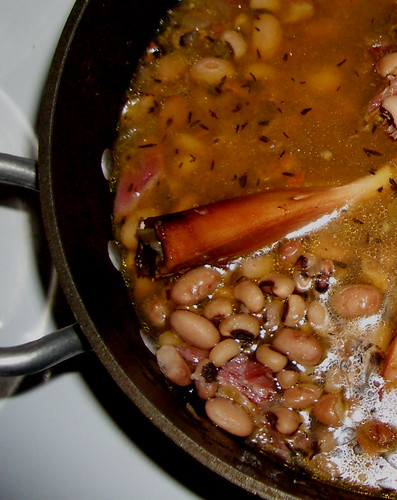
Watching the BEPI (Black-Eyed Pea Index)
Some people measure the economy's well-being counting cranes on the Manhattan skyline. Others by shower curtain sales. Today I found my own bellwether - sales of black-eyed peas on New Year's Eve.
Almost every year since I flew the nest in 1995, I've bought a bag of dried black-eyed peas on New Year's Eve, soaked them overnight, and made a pot of black-eyed peas and ham on New Year's Day. It's one of the things my mother drummed into me: you always say please and thank you; you never open an umbrella indoors; and you always, always, always have black-eyed peas and ham on New Year's Day.
Today, I went to two supermarkets. At both, shelves of dried beans were piled full - except where marked black-eyed peas, where they were bare. (At my second stop, I had to ask the manager, who got some from the back of the store for me.)
Every southerner knows you're chancing a poor and hungry year if you don't eat some black-eyed peas on New Year's Day. It seems like this year, even yankees are getting superstitious.

Almost every year since I flew the nest in 1995, I've bought a bag of dried black-eyed peas on New Year's Eve, soaked them overnight, and made a pot of black-eyed peas and ham on New Year's Day. It's one of the things my mother drummed into me: you always say please and thank you; you never open an umbrella indoors; and you always, always, always have black-eyed peas and ham on New Year's Day.
Today, I went to two supermarkets. At both, shelves of dried beans were piled full - except where marked black-eyed peas, where they were bare. (At my second stop, I had to ask the manager, who got some from the back of the store for me.)
Every southerner knows you're chancing a poor and hungry year if you don't eat some black-eyed peas on New Year's Day. It seems like this year, even yankees are getting superstitious.
Wednesday, December 17, 2008
My history with Scandinavia and disaster

A comment by Highland Capital's Paul Maeder at the MIT Venture Capital conference earlier this month got me thinking. He likened some investors to the Roadrunner, overshooting a ledge and realizing mid-canyon that a fall was in store. (I think that was Wile E. Coyote, but I won't nitpick.) The point is, the same thing has happened to me twice. Both times, Scandinavia was involved.
In spring of 2000, bored with my publishing job, I signed on as a copy writer for a Danish software maker. I was at IT FACTORY two months before I was laid off along with half the staff as the company began a long, slow crawl back to Copenhagen. Apparently, shenanigans ensued. Company president Stein Bagger disappeared in Dubai in November under a cloud of allegations that included massive fraud and hiring a Hell's-Angels beatdown of an associate.
After I got laid off, I continued to work as a freelancer for IT FACTORY. It took two planes crashing into the World Trade Center towers to make me realize the company hadn't paid any of my invoices since July. I sold their IBM Thinkpad, got a job as a courier and just barely made October rent.
Flash forward seven years. In spring, 2008, I was the transportation reporter for BostonNOW. Our fledgling free daily was backed by an Icelandic telecom. On April 11, I read that Iceland's economy was tanking. I was surprised three days later when, whilst viewing portraits in the National Gallery on a vacation to D.C., I got a text message informing me that our little paper was officially defunct.
At the time, I also had no inkling that Wall Street and the concept of wealth as we know it would burn like the California hills in October. I think for the rest of my life, anything that comes over the transom is going to get a careful nosing for the smell of disaster. Especially if the postmark looks Nordic.
Subscribe to:
Posts (Atom)